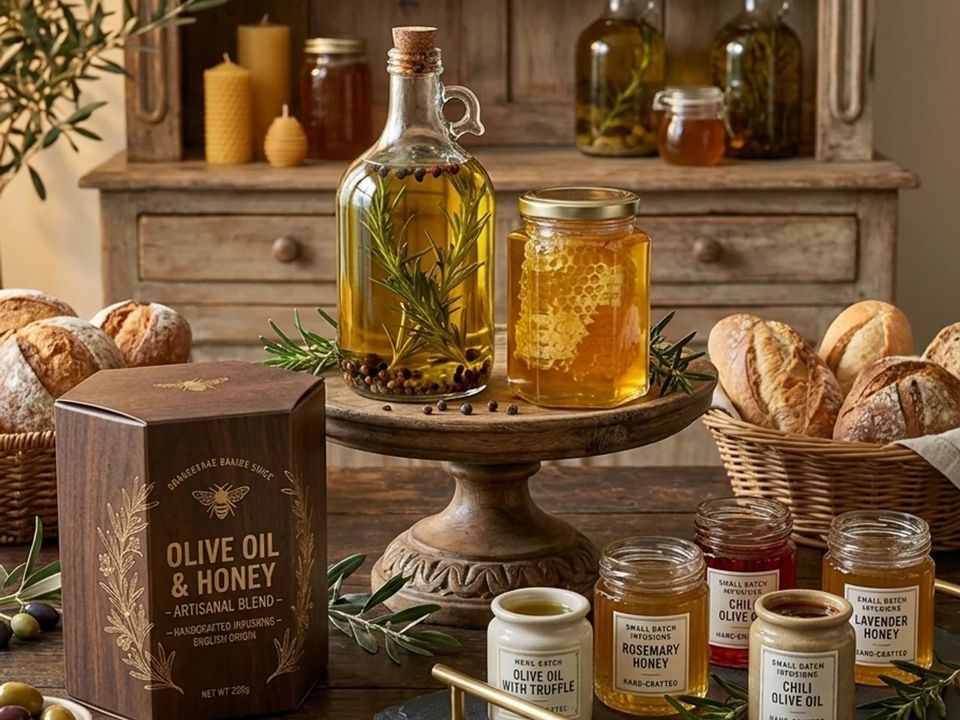
Two pantry staples with a very long history, and a very short routine
A three-minute editorial on old Mediterranean kitchens, the table they were built around, and the kind of small morning habit that outlived the houses it started in.
Old World Pantry·Culinary History·Table Traditions·Kitchen Notes·Harvest Notes·
Old World Pantry·Culinary History·Table Traditions·Kitchen Notes·Harvest Notes·
The editorial
The table came first, and the habit followed
Most old kitchens were organized around one piece of furniture. The table set the shape of the room, the order of the morning, and the short list of things that had to be within reach of it. What sat on the shelf above that table changed far less over the centuries than the room itself did.
Two of those things show up again and again in the written record of the Mediterranean: a jar of oil and a jar of honey. Not as a formula, and not as an idea about anything — simply as what a household kept, counted and carried from one season to the next. This editorial is about that shelf, and about a very short routine some readers say they borrowed from it.
Staple one
Olive oil
Pressed from the fruit of trees that can stand on the same plot for generations, olive oil belongs to some of the oldest written inventories we have of what a household kept indoors. It was stored in clay, moved by boat, counted as goods and listed alongside grain. The kitchens around it were rebuilt many times over. The jar stayed where it was.
Staple two
Honey
Honey appears in cave painting and in some of the earliest surviving texts of several separate cultures, long before anyone thought to write a recipe down. It kept through a season without any special handling, it travelled without spoiling, and for most of that history it was among the few sweet things an ordinary house could hold on to at all.
Inside the brief
What two of the oldest pantry staples have in common
Both were kept, counted and carried between seasons long before either one was written into a recipe.
The overlooked role of sitting down for a meal without rushing
Editorial notes suggest the setting of a meal shapes the habit around it as much as anything on the plate does.
Why starting small tends to stick longer than a full overhaul
In habit journals, some people write that the smallest version of a routine is the one still standing after a crowded week.
How an ordinary kitchen shelf can carry a very long history
Two jars, a board and a bit of bread: the shortest possible version of a table that has been set for a very long time.
Did you know?
The olive press is one of the oldest pieces of household technology still in everyday use
The stone press is one of the few kitchen processes a person from the ancient Mediterranean would probably still recognize on sight. The materials changed, the mechanics were refined many times over, and most of the work moved out of the house and into a mill. The idea underneath did not move at all: fruit, pressure, and a vessel waiting underneath.
That is part of why olive oil turns up so early and so often in old written records. It was not only something a household used — it was something a household had the equipment to make, store and account for.
The rest of the brief is in the presentation
It runs a few minutes, covers where these two staples sit in culinary history, and walks through the short morning routine some readers describe building around them.
This Privacy Policy explains how information is collected, used and protected when you visit this website. By using the site, you agree to the practices described below.
Information we collect
We collect two general categories of information:
Browsing data collected automatically, such as IP address, browser type, device type, operating system, referring page, pages viewed, and time spent on the site.
Information you choose to provide voluntarily, such as a name or email address submitted through a contact form or subscription field.
We do not ask for, collect or attempt to infer sensitive information, including religious belief, health information, biometric data or political opinion.
How information is used
Information is used to operate and improve the site, to understand how visitors navigate the content, to measure the performance of advertising campaigns, to respond to messages sent to us, and to comply with applicable legal obligations.
Cookies and similar technologies
This site uses cookies, pixels and similar technologies to remember preferences, keep the site functioning correctly and measure traffic. Some of these technologies may be placed by third-party advertising or analytics providers. Most browsers allow you to refuse or delete cookies through their settings. Disabling cookies may affect how parts of this site work.
Sharing with third parties
We do not sell personal information. Information may be shared with service providers that help us operate the site, such as hosting, analytics, email delivery and advertising platforms, and only to the extent needed to perform those services. Information may also be disclosed when required by law, court order or a valid request from a public authority, or to protect the rights, property or safety of the site, its visitors or others.
Your rights and choices
Depending on where you live, you may have the right to request access to the personal information we hold about you, to request correction of inaccurate information, to request deletion, to object to or restrict certain processing, and to withdraw consent where processing is based on consent. You may also opt out of marketing messages at any time using the unsubscribe link included in each message. Requests can be sent through the contact page.
Data retention
Information is retained only for as long as needed for the purposes described in this policy, or for as long as required by applicable law, after which it is deleted or anonymized.
Data security
We use reasonable technical and organizational measures designed to protect information against unauthorized access, loss or misuse. No method of transmission or storage is completely secure, and we cannot guarantee absolute security.
Adults only
This site is intended for an adult audience and is not directed at minors. We do not knowingly collect information from children. If you believe a child has provided information through this site, please contact us so it can be removed.
Links to other sites
This site may link to third-party websites, including advertisers and affiliate partners. We are not responsible for the privacy practices or content of those sites, and we encourage you to review their policies before providing information.
Changes to this policy
This policy may be updated from time to time to reflect changes in our practices or in applicable law. The revised version takes effect once published on this page, and continued use of the site after publication means you accept the updated policy.
Terms of Use
Last updated: 2026
Acceptance of these terms
By accessing or using this website, you agree to be bound by these Terms of Use. If you do not agree with any part of them, please do not use the site.
Permitted use
You may view, read and share the content of this site for personal, non-commercial purposes. You agree not to use the site to distribute unsolicited messages, to attempt unauthorized access to any system, to interfere with the normal operation of the site, to scrape or harvest content on an automated basis, or to use the content in any way that is unlawful or infringes the rights of others.
Intellectual property
The text, layout, graphics and other material published on this site are protected by intellectual property law and remain the property of the site operator or its licensors. Reproduction, republication or commercial distribution without prior written permission is not permitted.
Affiliate links and third-party sites
This site publishes sponsored content and may include affiliate links. If you click a link and complete a purchase, the site operator may receive compensation. Purchases are made on third-party websites, which are governed by their own terms, privacy policies, pricing, shipping rules and refund rules. We do not control those sites and are not responsible for their content, offers or practices.
Nature of the content
The content published here is editorial and educational, and deals with food history and household routine. It is presented in a historical and cultural context. It is not medical, nutritional, legal or financial advice, and it should not be treated as a substitute for professional judgment.
Consult a professional
You should consult a qualified healthcare professional before making any decision related to your health, diet or routine, particularly if you are pregnant or nursing, have a diagnosed condition, or take medication. Nothing on this site is intended to replace medical evaluation, diagnosis or treatment, and nothing here should be read as a reason to delay or avoid seeking professional care.
Disclaimer of warranties
This site and its content are provided on an "as is" and "as available" basis, without warranties of any kind, whether express or implied. We do not warrant that the content is complete, current or free of error, or that the site will be uninterrupted or free of harmful components.
Limitation of liability
To the fullest extent permitted by applicable law, the site operator shall not be liable for any indirect, incidental, special, consequential or punitive damages, or for any loss of profits, data or goodwill, arising out of your access to or use of this site or of any third-party site reached through it.
Changes to these terms
These terms may be revised at any time. The updated version takes effect once published on this page, and your continued use of the site after that point constitutes acceptance of the revision.
Governing law
These terms are governed by the laws applicable in the jurisdiction where the site operator is established, without regard to conflict of law principles. Any dispute shall be submitted to the competent courts of that jurisdiction.